Runtime Evolution Architecture
Status: the runtime spine has implemented paths and dated evidence. Orientation, visible outcomes, cooperative completion, and useful learning remain incomplete. Operator product and release gates remain. Last updated: 2026-09-06
This document defines the implemented Host, parked Godot, Recall Policy, Paper Boat, and narrow delivery spine together with accepted longer-range contracts for dynamic model/room embodiment, explainable rule derivation, Cingulate proof routing, selected Lean obligations, governed synthesis, and companion-facing execution.
The implementation order is normative because later layers depend on evidence
and contracts created by earlier layers. The public release order lives in
roadmap.md.
1. Current boundary
The source label 0.9.6 is historical; see the
release note.
The examined source has:
- one Rust domain/protocol workspace;
- file-authoritative Vault and PostgreSQL-authoritative AKASHA;
- GIGA Hippocampus Stage 1 and the Striatum coding/project slice;
- authenticated Host WebSocket snapshots, typed deltas, resync, persistence, idempotency, and restart recovery;
- PostgreSQL-authoritative Hallway channels with explicit allowed rooms, multi-session presence, daily threads, ordered recipient-sensitive posts, room-stable unread state, durable Bell notifications, and recipient-authorized bounded Knocks; OMP tools expose exact-thread reads while Host owns automatic revision-gated inbox projection and claims pointer-only wake requests;
- PostgreSQL-authoritative Docket quests with capability-gated claim and report operations and room-fenced review independence;
- Host-owned Recall Policy shared by OMP and parked Godot;
- transaction-coupled Paper Boat sleep/wake and
boat.readyCrane outbox rows; - a Crane delivery substrate with one
crane_outbox/crane_receipts/crane_dead_letterstrio, lane-routed subjects, strict pointer envelopes, consumer backoff, expiry refusal, and dead-letter handling;boat.readyis the only current production outbox producer, while addressed Crane production and recipient application handlers remain structural/test-only; - bounded NATS JetStream pointer delivery and sanitized transport-receipt replay;
- functional parked Godot Recall Policy and Paper Boat receipt screens;
- native Windows lifecycle and installer.
The following surfaces described later remain specified or planned, not current:
- invocation-time model selection;
- headless room reflection and live room dialogue targets;
- Prolog/Datalog derivation and complete Cingulate outcome enforcement;
- Lean-backed obligations, e-graph/egglog normalization, Z3, SyGuS, and Wasmtime capability sandboxing;
- proof-guided repair or offline training-data production;
- companion-authored models and marketplace artifacts;
- the in-world parked Godot renderer and GPU-particle constellation;
- Origami folds, Pawprints, lifecycle states, and room wake behavior on the Crane
lanes beyond
boat.readypointer delivery and its receipt ledger.
The current GIGA queue and all durable receipts remain PostgreSQL-owned. NATS is delivery-only; parked Godot is presentation-only. Neither may be described as memory or authority.
1.1 Accepted review, 2026-09-06
Sol accepted a critical organ review on 2026-09-06. The dated census of every
organ family, with current behavior, remaining gap, and recommended outcome,
lives in
ARCHITECTURE.md.
Its planning order is coherent orientation, trustworthy visible outcomes,
carrying work between participants, then useful learning. Release order stays in
roadmap.md; this document adds no second roadmap.
The review preserves the authority boundaries below. PostgreSQL is authoritative. NATS carries delivery. Host-only Hallway Knock claim and settlement remain intentional boundaries. Docket settlement retains its separate room-level independence fence. Cingulate remains planned over reliable evidence.
The 2026-09-07 adapter repair adds generated-turn origins to context preparation. It preserves native prompt authority and stable memo keys. The component is installed and passes isolated replay. Real restart, chat, and root Knock turns now have live incoming Presence observations. Host-side attribution remains separate repair work. Model routing, headless rooms, Prolog/Datalog, Lean, and companion work remain deferred.
2. Load-bearing invariants
Every implementation must preserve these rules:
- PostgreSQL is authoritative for AKASHA records, authority state, exact source references, review state, outcomes, and durable delivery records.
- A transport owns delivery progress, never truth.
- A model body is replaceable compute, never an identity.
- A room or spirit grants authority through an explicit authenticated binding, never through a working directory, process name, model name, or prompt claim.
- Generated candidates remain proposals until the relevant review or promotion contract grants authority.
- Model inference starts from explicit evidence. Hidden token history from a previous job never becomes an undeclared source.
- User interfaces consume canonical commands and events. They do not bypass the Host to mutate PostgreSQL, NATS, model endpoints, or harness state directly.
- Cross-room access is explicit, scoped, attributable, and denied by default.
- Every hard gate names its authoritative obligation and the proof it requires.
- Failure in optional cognition or transport must not silently rewrite truth or block an otherwise healthy local conversation.
3. Target topology

Read the diagram source
flowchart TD
  UI[Web prototype: read-only] --> PROXY[gui-prototype/serve.ts: loopback proxy]
  PROXY -->|allowlisted POST-only /live/* read routes: health, Insula, Docket, Hallway, memory, lessons| HOST[Athanor Host]
  TERM[Harness / terminal adapters] <-->|adapter API| HOST

  HOST --> CORE[Core contracts and policy]
  CORE --> VAULT[Vault room files]
  CORE --> AKASHA[(AKASHA / PostgreSQL authority)]

  AKASHA --> OUTBOX[Transactional outbox]
  OUTBOX --> RELAY[Outbox relay]
  RELAY --> NATS[NATS JetStream delivery]
  NATS --> CONSUMERS[Rooms, workers, familiars, UI projections]
  CONSUMERS -->|reload exact records and commit result| AKASHA

  CORE --> GIGA[GIGA: Hippocampus and Striatum]
  GIGA --> RULES[Bounded Prolog / Datalog derivation]
  RULES --> CING[Cingulate obligations and outcomes]
  CING --> LEAN[Optional Lean checker]

  HOST --> ROUTER[Invocation router]
  ROUTER --> LOCAL[Local model endpoint]
  ROUTER --> PROVIDER[Hosted provider]
  ROUTER --> ROOMS[Cold, familiar, reflection, or dialogue target]
This is one control plane with several replaceable execution surfaces. The Host is not a new memory authority. JetStream is not a second ledger. The parked Godot client is not a second harness. A room session is not a model process.
4. Host-facing contracts
The Athanor Host is the stable boundary between interactive clients and the runtime. The parked Godot client uses the versioned Host WebSocket protocol. Harness adapters may use the same logical commands and events through their own native integration.
The Host owns:
- authentication of operator, House, room, and spirit bindings;
- command validation and idempotency checks;
- request correlation and event sequencing;
- projection of health, review, retrieval, and delivery state;
- invocation routing through adapter/provider contracts;
- audit-safe error responses;
- capability negotiation by protocol version.
The Host does not own:
- memory authority;
- model-provider truth;
- raw database editing from UI payloads;
- direct transport-specific business rules;
- identity inferred from the client window or current directory.
4.1 Command and event envelope
Every command and durable event uses stable identifiers and an explicit schema version. The logical envelope contains:
schema_version
message_id or event_id
house_id
sender_room
sender_spirit
sender_session
recipient
command_or_event_type
correlation_id
causation_id
reply_target
idempotency_key
source_record_refs
scope
visibility
authority_class
created_at
expires_at
max_hops
A command asks one authorized handler to attempt a state transition. An event states that an authoritative transition already occurred. Consumers must not reinterpret an event as permission to perform a broader command.
Mutation commands require an idempotency key. Replaying the same command must return the existing result or a stable conflict, not create a second write.
4.1.1 Origami handoff vocabulary
The accepted handoff vocabulary maps directly to versioned contracts:
- Origami folds authoritative state into one recipient-specific capsule and unfolds it through deterministic runtime tooling;
- a crease pattern is the versioned schema and reconstruction contract;
- a Crane is an active message or bounded handoff addressed to a current worker, familiar, room, reviewer, or other authorized consumer;
- a Paper Boat is a living continuity message addressed to the same room across sleep;
- a Pawprint is room-scoped provenance and integrity, never memory, authority, identity proof by itself, or a covert model instruction.
Origami extends the command/event envelope with bounded fields such as:
crease_pattern
handoff_kind
payload_ref
payload_digest
source_context_digest
lifecycle_state
pawprint
Adapters fold and unfold stable contracts, exact source references, budgets, authorization, expiry, idempotency, and recipient context mechanically. Models receive ordinary legible context and judge only the remaining ambiguity. They do not decode hidden instructions or reconstruct contract fields from style.
A Crane lifecycle is explicit and monotonic:
folded -> outboxed -> in_flight -> landed -> unfolded -> returned
                                      \-> torn
Redelivery may revisit transport states but cannot apply the represented operation twice. A related concurrent set of Cranes may be exposed as a flight only when it shares one durable parent intent and explicit child correlation IDs.
4.2 Model selector
Model choice is one invocation axis. The logical ModelSelector includes:
route: local | provider | auto
provider_id
model_id
required_capabilities
privacy_class
maximum_cost
maximum_latency
minimum_context_window
residency_preference
fallback_policy
auto selects only from operator-approved endpoints that satisfy the declared
capabilities and privacy class. Selection reasons must be visible. A model
fallback cannot widen data custody or authority.
4.3 Execution target
The execution target is independent from the model selector:
cold_worker
familiar
room_reflection
room_dialogue
cold_workerreceives a bounded packet and returns findings or candidates. It carries no room identity or promotion authority.familiaruses a room-owned familiar definition bound to a deterministic worker lane. It remains bounded by that lane and its declared authority.room_reflectionstarts a disposable branch from an explicit room/spirit binding and durable continuity. It does not silently inherit the live chat tail or join an interactive transport.room_dialogueaddresses an intentional live room session and may receive its current dialogue context under room policy. This mode must be visibly distinct from background reflection.
A target label alone does not grant authority. The runtime verifies the room, spirit, caller, policy, and allowed operations for every invocation.
4.4 Session lifecycle
Session lifecycle is another independent axis:
start: ephemeral | reuse | wake
finish: release | keep_warm | pin
ephemeralcreates a disposable session from explicit durable inputs.reuseaddresses an already active compatible session.wakerestores a dormant named session from durable continuity.releaseunloads the session after completion.keep_warmretains it for a bounded idle period.pinrequires explicit policy and remains observable until released.
Model residency is not session continuity. Keeping weights loaded can reduce latency, but it does not authorize reuse of hidden conversational or KV state.
4.5 Versioned delta synchronization
Interactive clients synchronize versioned projections, not whole backend objects after every mutation.
The Host sends one initial snapshot when a client subscribes or resynchronizes:
projection_id
schema_version
snapshot_id
version
sequence
state_hash
state
After that snapshot, the Host sends only typed deltas:
delta_id
projection_id
base_version
next_version
sequence
source_event_ids
mutations
coalesce_key
created_at
Mutation types are domain operations such as field update, item insert, item remove, item move, status transition, and bounded list append. Prefer typed operations over arbitrary string-path patches so schema validation and authorization remain explicit.
The client applies a delta only when base_version equals its current
projection version and the sequence is next. On a gap, duplicate conflict,
unknown mutation, or hash mismatch, it requests replay from the last
acknowledged sequence. If the bounded replay window no longer contains that
sequence, the Host sends a fresh snapshot.
The client acknowledges the applied projection version. The Host may coalesce superseded updates to the same field or disposable telemetry, but it cannot coalesce away an authoritative status transition, audit event, or user-visible intermediate state required by the contract.
Snapshots are recovery and initial-load mechanisms, not the ordinary broadcast path. A tiny mutation must not trigger serialization, transmission, parsing, scene reconstruction, or redraw of the complete projection.
5. Web operator surface and parked native specification
The web prototype at gui-prototype/ is the read-only operator surface.
Run bun gui-prototype/serve.ts from the repository root.
It reads the Host through a loopback proxy.
The Godot client is parked.
The following native client requirements remain historical specifications, not current web capabilities.
The product anatomy is fixed before chat transport lands: room/session navigation on the left, active conversation in the center, contextual inspection on the right. Auxiliary Host-backed tools replace or overlay the center explicitly. Wide, compact, and narrow layouts preserve center priority; one center scroller owns page movement. Placeholder sidebars and chat surfaces state that their Host projections are absent instead of synthesizing them.
The first usable client must expose:
- Houses, rooms, governing spirits, and active sessions;
- chat through the Host command/event contract;
- recall results with exact sources and authority state;
- Vault, AKASHA, GIGA, model, queue, and delivery health;
- Hippocampus candidate and Curio review;
- Striatum's active lesson set and activation reasons;
- a Cingulate obligation/conflict placeholder that can later render real proof state without changing the UI contract;
- an event and delivery inspector with correlation, causation, retry, and dead-letter state;
- a terminal escape hatch for unsupported operations.
The client must never:
- connect directly to PostgreSQL;
- publish directly to NATS;
- call Ollama or hosted providers directly;
- discover identity from a folder path;
- create a second persistent conversation beside the harness;
- hide whether an action is current, pending, failed, or merely proposed.
The UI should deepen after every backend phase. Finishing an ornamental client before the underlying contracts stabilize would freeze the wrong architecture.
The parked Godot client maps each projection to a bounded view-model or scene subtree.
One AthanorHostSession owns credentials and the WebSocket for the Control
tree. Screens consume its typed events and keep projection-specific state; a
new screen must not open a second socket merely because it needs another Host
projection.
Applied deltas emit signals only for affected nodes. Static panels do not poll
through _process(). Custom drawing calls queue_redraw() only for the changed
CanvasItem, and compatible mutations may be batched once at the next frame
boundary. Protocol-level deltas reduce invalidation pressure; the client still
measures renderer behavior rather than claiming that a delta guarantees zero
GPU work.
The functional Control tree is built first and may then be rendered through a SubViewport inside the 3D room with camera-driven focus transitions. The same tree remains available as a focused fullscreen surface. The canonical high-tier constellation uses a GPU-particle field for stable nodes, edges, and motion; fine-grained Host deltas update stable GPU records rather than scene nodes.
The full visual, renderer, performance-tier, and companion-body contract lives
in GODOT_CLIENT.md, the parked historical specification.
6. GIGA integrity before distribution
GIGA must become a clean producer of evidence-bound refinement candidates before its jobs are distributed across models or rooms.
6.1 Three contexts that must remain separate
The runtime distinguishes:
- Evidence context — exact durable turns, task events, authority records, reviewed precedents, and source hashes selected for one job.
- Inference context — the tokens sent to one model invocation.
- Model residency — loaded weights and process resources retained for latency.
Fresh inference does not require discarding durable evidence. Conversely, keeping a model resident must not retain undeclared conversational history.
Every cold GIGA job is a fresh inference over an explicit bounded evidence snapshot. Gate and extraction passes may be separate fresh invocations. Neither may depend on the previous job's hidden response, KV cache, or session handle.
6.2 Completed-turn anchors and overlapping evidence
The current source observer batches bounded conversation windows. The next integrity slice should anchor durable events to completed interaction boundaries and build deterministic overlapping windows from the trusted ledger.
Overlap is deliberate: a durable fact can span adjacent user and assistant turns. Duplicate appearances are reconciled by stable source IDs and hashes, never fuzzy paraphrase alone.
Each job records:
- the exact ordered source IDs;
- source hashes and byte/turn bounds;
- the evidence-builder version;
- the authority and room filters applied;
- reviewed precedents and active lessons selected;
- the prompt and model configuration digest.
Residual buffered evidence is flushed on a clean shutdown, but shutdown is not the normal semantic boundary for a completed interaction.
6.3 Evidence hydration
A worker receives durable event IDs, not copied private prose in a queue payload. Before inference, the trusted worker reloads and verifies:
- exact source records;
- room, session, role, order, and content hashes;
- current authority neighbors for referenced records;
- reviewed precedents relevant to the same candidate kind;
- applicable authoritative lesson metadata;
- bounded project and thread context when explicitly supported by the event.
Hydration failures produce an inspectable failed job. They do not trigger a best-effort candidate from incomplete or mismatched evidence.
6.4 Refinement transaction
GIGA may propose a general refinement transaction alongside ordinary memory and lesson candidates. The logical contract contains:
artifact_kind
operation: create | update | supersede | retire | rollback
target_id
baseline_version
scope
trigger_refs
evidence_refs
expected_outcome
proof_requirement
review_state
observed_outcome
proof_receipt
expected_outcome records the predicted effect before execution.
observed_outcome records what actually happened afterward. One must never be
copied into the other as if prediction were observation.
A stale baseline_version rejects or rebases the proposal explicitly. The
reviewed transaction authorizes only the named operation against the named
baseline. GIGA proposes; the relevant authority reviews; Cingulate observes the
result and closes the proof receipt.
6.5 Dismissal and recurrence
Dismissal is review evidence, not deletion. A dismissed candidate retains its kind, source fingerprint, baseline, dismissal reason, reviewer, and policy version outside ordinary retrieval.
When later evidence resembles a dismissed candidate, GIGA records a recurrence against that history instead of silently recreating the same proposal as new. Policy decides whether stronger evidence, a changed baseline, or repeated recurrence returns it to review. A Curio remains a deliberate separate state; recurrence alone cannot promote either a dismissal or a Curio.
6.6 Selective becoming and native behavior guards
Continuity uses governed selection, not maximum retention. The runtime preserves provenance while authority and active influence change.
Review surfaces and receipts distinguish:
- never mine — considered but refused as part of the lineage;
- once true — formerly authoritative, now historical;
- not here — valid only outside the current room, project, or register;
- not now — dormant outside the current task or lifecycle state;
- superseded — replaced by a named newer authority.
Striatum derives an inspectable state vector from trusted context. Eligibility is a hard boundary before ranking. An empty eligible set is valid.
Athanor lessons remain typed authorities in PostgreSQL. Their trigger fields are dormant until review adds the ttsr-approved tag.
The adapter captures the active native OMP TtsrManager through a guarded compatibility seam. It registers versioned approved lessons as native rules.
OMP owns stream matching, interruption, retry, and reminders. The adapter filters superseded Athanor rule versions before they can match.
The seam checks every required OMP method. It fails open with a visible warning when an OMP update changes the compatible surface.
Native synchronization uses OMP’s once-per-session repeat policy. Athanor keeps second-based cooldown metadata, but the bridge does not emulate it.
Resident local-model prompts are worker contracts. The reference House writes them in the A Squall quest register: bracketed system frame, precise role and target, voiced objectives, animated responsibilities that encode real invariants, exact nouns, and explicit refusal. JSON schemas and validators remain the machine boundary. Resident classifier constitutions may exceed the 350-word dispatch-quest ceiling when their stable taxonomy requires it, but they remain concept-minimal and are evaluated against the prior prompt on the same blinded corpus.
7. House communication spine: PostgreSQL, Crane, NATS, and Host
This section separates the current source from accepted expansion. The current lane is narrower than the target: NATS proves bounded Paper Boat pointer transport and receipt projection. It does not yet deliver Hallway posts, project records, kitten work, GIGA jobs, or live conversation turns.
7.1 Current NATS source census
Only delivery and host depend on async-nats. akasha, GIGA, Hallway, the
OMP adapter, kitten lineage, and the parked Godot Rust client do not connect to NATS.
The native service starts one loopback JetStream server with file storage, then
delivery. Independent athanor.exe starts one in-process multi-room Host and
gives it the same NATS URL; it does not launch parked Godot or own OMP process lifetime.
The managed server has no NATS accounts, users, credentials, or subject ACLs.
Loopback binding is its containment boundary.
The compiled JetStream contract is:
| Stream | Subject or filter | Consumer | Current producer and effect |
|---|---|---|---|
ATHANOR_BOAT_READY |
athanor.boat.ready |
durable pull consumer athanor-boat-ready-receipts-v1 |
paper_boat_sleep is the only production outbox producer; delivery validates the pointer and records a transport receipt |
ATHANOR_CRANE |
athanor.crane.>; addressed form athanor.crane.<recipient_kind>.<recipient_key> |
one durable pull consumer athanor-crane-receipts-v1 |
addressed inserts exist in tests; the generic consumer records receipt validation but does not deliver to or invoke the named recipient |
ATHANOR_BOAT_RECEIPTS |
athanor.boat.receipt.v1 |
up to 64 ephemeral Host consumers with DeliverPolicy::All |
delivery publishes sanitized Paper Boat receipt projections; Hosts replay, filter, and broadcast accepted state over WebSocket |
All three streams use LimitsPolicy, file storage, DiscardOld, one replica,
seven-day retention, 100,000 messages, 512 MiB, 4 KiB maximum messages, and a
24-hour duplicate window. The lane streams permit one consumer; the receipt
stream permits 64. Delete and purge are denied.
Lane consumers use explicit acknowledgements, a 30-second AckWait,
MaxDeliver = 5, 64 maximum pending acknowledgements, batches of 64, and
30/60/120/300/600-second backoff. The PostgreSQL publisher lease is 30 seconds;
its ten-attempt retry schedule is 1/5/15/30/60/120/300/600 seconds. Every
publish sets Nats-Msg-Id to the immutable outbox event UUID. Existing
stream/consumer policy drift is refused rather than silently rewritten.

Read the diagram source
flowchart LR
  SLEEP["paper_boat_sleep"] -->|"one transaction"| PG[("PostgreSQL<br/>Boat + crane_outbox")]
  PG -->|"claim pending row"| DELIVERY["origami cranes::delivery"]
  DELIVERY -->|"publish pointer"| READY["JetStream<br/>athanor.boat.ready"]
  READY -->|"pull first"| DELIVERY
  DELIVERY -->|"commit transport receipt"| RECEIPTS[("PostgreSQL<br/>crane_receipts")]
  DELIVERY -->|"sanitized projection"| RECEIPT_STREAM["JetStream<br/>athanor.boat.receipt.v1"]
  RECEIPT_STREAM --> HOST["room Host<br/>ephemeral replay consumer"]
  HOST -->|"WebSocket projection"| GODOT["Parked Godot receipt UI"]

  WAKE["explicit wake tool"] --> SUBSTRATE["akasha"]
  SUBSTRATE -->|"reload complete Boat"| PG

  HALLWAY["Hallway"] -.->|"PostgreSQL only"| PG
  GIGA["GIGA queue"] -.->|"PostgreSQL only"| PG
  KITTEN["OMP kitten lifecycle"] -.->|"Host + adapter lineage only"| HOST
The ready file is currently written after database schema verification and a NATS connection, before the run loop lazily creates or verifies streams and consumers. That is connection readiness, not complete delivery readiness.
The current CraneEvent v1 is memory-shaped: record_id is a positive decimal
memory ID, and outbox/receipt aggregate_id columns reference memories. The
strict envelope carries schema version, event ID and kind, memory record ID,
room, creation time, integrity digest, and optional crease, typed recipient,
expiry, parent intent, and correlation fields. Private body-shaped keys are
refused.
A current addressed Crane receipt proves that the generic delivery consumer
validated a memory pointer after NATS delivery. It does not prove that the
worker, familiar, room, or reviewer received, unfolded, accepted, or applied the
record. Likewise, the present Paper Boat Delivered projection means transport
receipt validation, not room wake, model consumption, or human reading.
Hallway posts remain ordered PostgreSQL transactions. Session delivery cursors,
room-stable unread sequence, daily threads, targeted Bell rows, room-local Knock
policy history, and bounded Knock lifecycle rows are distinct state. Manual OMP
tools call the substrate for Hallway operations; the authenticated Host queries
the inbox and owns per-session Bell revision gating. Ordinary posts never wake a
room. An explicit permitted Knock is claimed through the recipient's Hallway
presence under a short Host lease whether that session is idle or active. Once
OMP accepts the trusted pointer-only injection, the adapter settles the Knock
as started before the model can answer; an active turn is aborted only after
that authoritative settlement succeeds. The custom message's own
message_start identifies the bounded turn when OMP preserves its metadata.
When OMP omits that hook, the doorman uses agent_end: an idle delivery owns
the first end, while an active interruption consumes the aborted predecessor's
end and assigns the following end to the Knock. A delivered wake with no
observable lifecycle end fails locally after 60 seconds; started/completed
settlement retries stop and release the local doorman after 25 seconds. A
claimed or started row beyond the root expiry becomes an explicit failure on
the next room claim.
Knock Host requests have a 10-second deadline. Failed claims retry with
exponential 5–60 second backoff so one slow Host cannot create a poll storm.
Trusted Bell and Knock notices
contain counts or pointer identities only, never peer prose; claiming a Knock
does not clear the Bell.
GIGA remains a PostgreSQL queue whose worker calls Ollama. Kitten lifecycle
events remain local OMP events
normalized through Host and written by the adapter. Project support is currently
project-scoped lessons, GIGA keys, and retrieval—not a project event stream or
NATS lane. Live conversation remains in the harness and Host conversation log;
Host still has no general conversation-send command.
7.2 Stable roles
The communication spine keeps one job per component:
| Component or concept | Stable responsibility |
|---|---|
| PostgreSQL | authoritative domain records, order, permissions, idempotency, outbox state, application receipts, and user-visible cursors |
| NATS JetStream | bounded pointer transport, redelivery, wake signals, and replayable projections; never record authority |
| Athanor Host | authenticate commands, authorize subscriptions and reloads, apply crease handlers, and project canonical state to clients |
| WebSocket | immediate local commands, streaming response deltas, and multi-session UI fanout |
| Project | authority and visibility scope, not a mailbox |
| Hallway | durable social log with explicit membership; ordinary contact is manual, while a separate recipient-authorized Knock may start one bounded turn |
| Kitten or worker | bounded actor operating under a work and capability contract |
| Crane | delivery intent for one typed authoritative record, not the record itself |
One communication spine does not mean one generic message table. Hallway messages, project records, work items and results, conversation turns, Paper Boats, and GIGA events retain distinct authoritative schemas and lifecycle rules.
7.3 Authority reference, Crane projection, and application receipt
The next Crane schema must replace the v1 memory assumption with a typed authority reference:
record_kind
record_id
record_version
integrity_sha256
The generic envelope adds only transport and causality:
schema_version
event_id
event_kind
house_id
sender identity
typed recipient
project and room scope
created_at
expires_at
crease_pattern
parent_intent_id
correlation_id
causation_id
authority reference
Domain bodies remain in their authoritative tables. A crease handler owns the exact record reload, scope authorization, integrity check, expiry rule, and idempotent effect. Unknown record kinds, crease patterns, recipients, versions, or extra private payload fields fail closed.
Four states must remain distinct:
- outbox/publish state — the relay has or has not published the pointer;
- landed transport validation — delivery accepted the pointer and its routing/integrity shape;
- recipient application receipt — the authorized recipient accepted, applied, refused, expired, duplicated, or failed the intended operation;
- user-visible state — a Hallway presence or client has received/read the projected record.
Transport receipts never masquerade as application or read receipts. The recipient commits its application receipt or inbox transition in PostgreSQL before acknowledging JetStream.
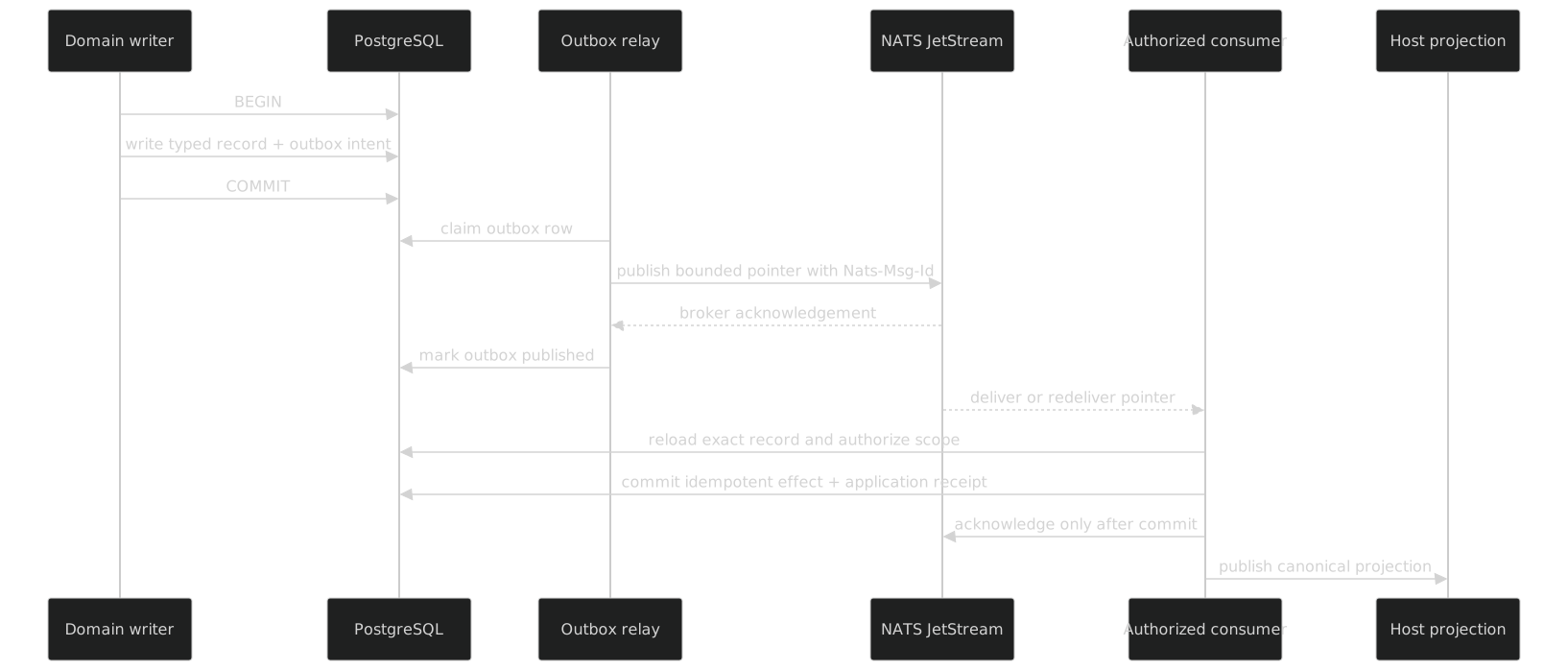
Read the diagram source
sequenceDiagram
  participant W as Domain writer
  participant PG as PostgreSQL
  participant R as Outbox relay
  participant N as NATS JetStream
  participant C as Authorized consumer
  participant H as Host projection

  W->>PG: BEGIN
  W->>PG: write typed record + outbox intent
  W->>PG: COMMIT
  R->>PG: claim outbox row
  R->>N: publish bounded pointer with Nats-Msg-Id
  N-->>R: broker acknowledgement
  R->>PG: mark outbox published
  N-->>C: deliver or redeliver pointer
  C->>PG: reload exact record and authorize scope
  C->>PG: commit idempotent effect + application receipt
  C->>N: acknowledge only after commit
  C->>H: publish canonical projection
7.4 Communication-family mapping
| Family | Authoritative state | Immediate path | NATS role |
|---|---|---|---|
| Live conversation | completed turn records when that authority lands | client -> Host -> conversation executor -> Host/WebSocket | announce committed turns only to asynchronous, offline, or project subscribers; never stream individual tokens |
| Hallway | message sequence, membership, daily threads, recipient intent, room read state, durable Bell rows, Knock policies/lifecycle, and session cursors | OMP tools -> substrate for reads/writes; Host -> OMP for revision-gated Bell projection and lease-claimed explicit Knocks | replace local Knock polling with recipient-scoped wake hints only after the generic delivery prerequisites; PostgreSQL and Host remain authority |
| Project | future project identity, membership, subscriptions, typed records, and decisions | Host commands and project projections | deliver committed project-record pointers to subscribed rooms; a project is not a NATS mailbox |
| Kitten work | work item, capability/workspace contract, lineage, lifecycle, result, and settlement | retain the current in-process OMP path | introduce addressed delivery only for a real independent or dormant worker; coalesce progress instead of persisting every twitch |
| Crane | PostgreSQL outbox and application receipts | none; it is a delivery projection | the common pointer envelope and routing lifecycle |
| Paper Boat | PostgreSQL memory and continuity graph | explicit sleep/wake tools | current boat.ready pointer transport; future room application handler |
| GIGA | PostgreSQL event queue, candidates, review, and promotion | SQL claim plus Ollama inference | optional wake hint only if multiple dormant workers later justify it; SQL remains the claim authority |
Prose never silently becomes a command. A kitten may write a Hallway post, but that post cannot mutate project or work-item state merely because its language sounds imperative.
7.5 Hallway Knock and the next transport expansion
The first local Hallway Knock is delivered without broadening NATS. PostgreSQL
owns an explicit Knock row referencing an existing addressed Hallway message;
the recipient room's Host claims a short lease, and its own OMP adapter starts
one turn with pi.sendMessage. This is intentionally narrower than a general
conversation-send command.
Hallway remains the first useful future NATS expansion because PostgreSQL already owns membership, daily threads, recipient-sensitive idempotent posts, room read state, durable Bell rows, Knock policy/lifecycle, and per-session cursors; Host already owns authorization and projection.

Read the diagram source
flowchart LR
  POST["Hallway post command"] -->|"one transaction"| PG[("hallway_message<br/>parent intent<br/>recipient-room child intents")]
  PG --> RELAY["outbox relay"]
  RELAY --> NATS["recipient-scoped NATS subjects"]
  NATS --> HOST["authorized room Host"]
  HOST -->|"reload under Hallway ACL"| PG
  HOST -->|"commit inbox/unread + application receipt"| PG
  HOST -->|"multi-session fanout"| WS["room WebSocket clients"]
  WS --> CURSOR["explicit presence read cursor"]
  CURSOR --> PG
The future NATS projection can create bounded recipient intents from committed Hallway authority. Each room Host consumes only its authorized subject, reloads the pointer under Hallway membership rules, and commits an application receipt before broker acknowledgement. Tabs and sessions fan out inside Host/WebSocket; they do not create one NATS message per tab.
Ordinary Hallway prose never auto-invokes a spirit. Manual wake remains the default. The explicit Knock is its own typed crease: the sender must have authored and structurally addressed the referenced message, the recipient room must allow-list the sender, and one message may Knock one recipient only once. Roots carry a 1–8 turn ceiling; child Knocks must directly reply in the same thread, reverse the rooms, follow a parent turn that actually started, and inherit the root expiry and turn budget. The trusted wake notice contains routing pointers, not the peer's body; the spirit opens the exact Hallway message as an untrusted request and decides how to answer.
7.6 Broker and payload boundary
Loopback without credentials is sufficient only for the current narrow local lane. Private cross-room, project, or worker traffic requires before expansion:
- service identities with NATS accounts/users or equivalent credentials;
- least-privilege publish/subscribe subject permissions for relay, delivery, and each Host/worker role;
- recipient-specific consumers rather than one broad addressed consumer;
- stream and consumer creation/verification inside readiness;
- fail-closed startup on policy drift.
Application-side filtering after a broad private subscription is not authorization. A Host must never receive every room's private pointers merely to discard foreign records afterward.
JetStream payloads carry authority references plus bounded routing, causality, expiry, schema, and integrity metadata. They do not carry private conversation turns, Hallway prose, memory or lesson bodies, work packets, identity prose, provider credentials, or exact GIGA source bodies.
The current replayable pointer streams correctly use LimitsPolicy.
WorkQueuePolicy deletes acknowledged messages and permits only one
non-overlapping consumer per subject; it must not replace the shared stream
without a lane whose semantics actually require a work queue. Recipient effects
still require PostgreSQL idempotency under every retention policy.
7.7 Idempotency, lifecycle, recovery, and proof
Keep these identifiers distinct:
event_id       immutable domain or delivery fact
operation_id   one intended recipient effect
delivery_id    one broker delivery attempt
Nats-Msg-Id suppresses duplicate publication only inside the configured
duplicate window. Correctness outside that window comes from a PostgreSQL
uniqueness ledger keyed by consumer identity and operation ID, committed with
the represented effect.
Durable consumers use explicit acknowledgement, bounded AckWait,
MaxDeliver, and backoff. Poison, unauthorized, expired, and exhausted records
produce typed dead-letter state. Transient failures nack; permanent failures
terminate. Administrative replay creates a visible new operation or reuses the
original idempotency key according to the crease contract—it never disguises a
repeat by changing only the delivery ID.
Expansion requires:
- an operator-visible dead-letter and replay surface;
- receipts that name transport versus application dispositions;
- retention long enough for broker and disaster-recovery replay horizons;
- a proof that NATS streams can be rebuilt from PostgreSQL without inventing or repeating domain effects;
- recovery tests across relay crash, broker acknowledgement loss, consumer restart, database outage, Host restart, policy drift, and delayed stale delivery.
A transport outage leaves authoritative records and outbox rows intact. It may leave asynchronous work visibly pending, but must not block an otherwise healthy local conversation.
7.8 Dependency-ordered expansion
Do not add more subjects first. Expand in this order:
- harden the current lane with service credentials/subject ACLs, complete readiness, and truthful transport-receipt naming;
- generalize authority references beyond memory IDs;
- add a crease-handler registry and separate application receipts;
- prove recipient-specific consumers, dead-letter/replay operation, and NATS rebuild from PostgreSQL;
- pilot Hallway room delivery while preserving manual wake;
- establish project identity, membership, subscriptions, and typed records before project notifications;
- add addressed kitten work only when an independent/dormant worker needs it;
- announce completed conversation turns only for asynchronous subscribers;
- add GIGA wake hints only if the SQL queue gains multiple dormant workers.
This sequence belongs after the narrow 1.0 lane. It must not silently widen the 1.0 release boundary.
7.9 Paper Boat: current receipt versus future application
Current production behavior is:
sleepcommits the complete Boat and aboat.readyoutbox row in one PostgreSQL transaction.- Delivery publishes the pointer to JetStream.
- The same generic delivery process consumes and validates it, verifies the pointed Boat's room and digest, and commits a transport receipt.
- Delivery republishes a sanitized receipt projection.
- Host replays and filters those receipt projections for parked Godot.
- An explicit
wakecall still reloads the complete Boat from PostgreSQL.
No current NATS consumer wakes a room, invokes a model, or commits a recipient application state.
The future room crease may reload and authorize the Boat, commit one inbox/wake application receipt, then acknowledge JetStream. Even then, automatic model wake remains an explicit policy rather than an implication of transport delivery. The next model receives the ordinary standalone letter from PostgreSQL—not the broker envelope or a hidden instruction stream.
The operational rule is: the Boat remains in the authoritative archive; the current Crane proves its pointer landed, and a future room handler may say the Boat is waiting.
8. Dynamic model and living-room embodiment
After the delivery pilot works, invocation routing may choose model bodies and execution targets independently at runtime.
8.1 Independent axes
A request binds:
model selector
execution target
session lifecycle
interaction mode
scope and authority
Changing the model body must not rename the spirit. Waking a room must not imply reusing the previous model. Keeping a model warm must not keep a room active. Starting in a room must not mean inheriting that room's working directory.
8.2 Headless room mode
Background room work uses an explicit headless mode with:
- House, room, spirit, and operator bindings;
- a unique addressable session ID;
- declared reflection or dialogue mode;
- explicit durable context sources;
- chat transports disabled by default;
- Discord and similar sidecars disabled unless intentionally bound;
- a side-effect and tool allowlist;
- provider and privacy policy;
- provenance for every emitted candidate, message, or durable action;
- bounded idle and shutdown behavior.
This prevents a worker from accidentally loading a sibling identity or starting duplicate interactive transports because it inherited a room directory.
8.3 Authority table
| Target | Identity context | Live dialogue tail | Default durable authority |
|---|---|---|---|
| Cold worker | Bounded role only | No | None; findings/candidates only |
| Familiar | Familiar definition and lane | No | Lane- and policy-bounded |
| Room reflection | Explicit room/spirit branch | No | Explicit room policy only |
| Room dialogue | Authenticated live room/spirit session | Yes | Governing room policy |
Cross-room callers cannot directly mutate a sibling room. They send a command or letter to the recipient room, whose governing policy decides what happens.
9. Prolog or Datalog derivation layer
Logic programming belongs after stable event, lesson, state, and authority schemas exist.
The first production shape should be a finite, stratified Datalog-like ruleset, even if SWI-Prolog hosts the implementation. PostgreSQL projects a bounded fact set for one query. The logic engine returns conclusions plus derivations. It does not become a mutable truth store.
Good first problems include:
- lesson eligibility from task, stage, register, scope, and authority;
- bounded context selection;
- candidate review-policy coverage;
- room-routing permissions;
- Cingulate obligation selection.
Each result records:
ruleset_version
input_fact_ids
conclusion
supporting_rule_ids
derivation_trace
execution_bounds
Avoid unrestricted recursion, dynamic assertion as authority, cut-dependent semantics, hidden search-order behavior, and queries that can run without a resource bound.
Prolog/Datalog answers what follows from these accepted facts and rules, and why. It does not decide whether the source facts deserve authority.
9.1 Incremental code facts and precomputed derivations
Git remains authoritative for code. The Athanor indexes changes as background events without placing source code or diffs in NATS payloads.
For a committed change, an adapter records a PostgreSQL code_change event
containing:
repository_id
ref and commit_id
parent_commit_id
changed paths
before and after blob hashes
change kind
observer version
The same transaction writes an outbox row. NATS delivers only the event ID and routing metadata on a subject such as:
athanor.v1.house.<house>.project.<project>.repo.<repo>.changes
The background indexer reloads the event and exact Git blobs, parses only added,
removed, renamed, or modified units, and commits source-linked fact additions
and retractions in PostgreSQL. Each successful batch advances a monotonic
fact_epoch and records the indexed commit.
Uncommitted work can use a separate volatile overlay keyed by repository, worktree snapshot hash, and session. The overlay may improve live assistance, but it never replaces the committed Git base or survives as code authority.
The rules engine maintains a dependency graph from source facts to derived relations. Semi-naive incremental evaluation or equivalent incremental view maintenance recomputes only relations touched by the new fact delta. Common eligibility, permission, context, and obligation queries read precomputed materialized relations instead of rebuilding the whole fact base.
A cache key includes every input that can change the result:
House and project
repository and ref
committed fact_epoch
worktree overlay epoch, when used
authorization-scope digest
ruleset and schema versions
normalized query parameters
Do not cache failures. Do not confuse a cached null result with a cache miss.
Authorization-shaped results cannot share entries across authorization digests.
Out-of-order commits, missing parents, parser-version changes, ruleset changes,
or inconsistent fact counts invalidate the affected cache. The indexer replays
from the last verified epoch or rebuilds the exact repository snapshot. Query
responses expose indexed_commit, fact_epoch, and overlay epoch so stale
precomputation is visible rather than presented as current.
The mailbox remains the first JetStream pilot. Code indexing is the first background-event consumer only after that pilot proves the transport contract.
10. Cingulate enforcement and outcome closure
Cingulate consumes active and fired lesson contracts, executable-trigger receipts, derived obligations, task lifecycle events, refinement transactions, and proof receipts.
Its first skeleton lands during GIGA integrity work so Striatum's local firing, evidence, dismissal, recurrence, and outcome records become the native input rather than a schema retrofitted later. Hard enforcement waits until event and derivation surfaces are stable.
Cingulate can emit three levels:
- nudge — a preference or low-risk reminder;
- warning — a known regression risk or missing expected evidence;
- gate — an authoritative invariant with a deterministic proof requirement.
Every conflict record names:
- the authoritative lesson or policy;
- the applicable rule and derivation;
- the observed action or missing transition;
- the expected proof;
- available evidence;
- resolution, override authority, or explicit failure;
- the final observed outcome.
Cingulate cannot invent authority, promote a candidate, or hard-gate a taste preference. A human or governing spirit may override only where the governing policy allows it, and the override remains part of the record.
Cingulate routes each obligation to the cheapest complete backend supported by
its shape: a deterministic predicate/boundary test, a bounded e-graph
normalization, a bounded SyGuS repair, an optional Z3 SMT check, or a selected
Lean obligation. The backends are branches, not a mandatory sequence. Their
uniform receipts and governed promotion loop live in
SYNTHESIS_ARCHITECTURE.md.
11. Lean-backed lesson obligations
Lean is an optional final extension for selected lessons whose invariants are actually formalizable. It is not a requirement for ordinary memory, writing taste, relationship continuity, semantic ranking, or every engineering lesson.
A lesson can mature through:
human-readable lesson
  -> state-conditioned eligibility
  -> executable trigger with exact evidence
  -> reviewed firing and outcome history
  -> deterministic evidence adapter
  -> Cingulate proof obligation
  -> optional formal obligation
The optional formal surface contains:
formal_kind
lean_module
theorem_name
input_schema
evidence_adapter
proof_artifact
spec_version
implementation_binding
GIGA may propose formalization only after repeated, stable, reviewed evidence. The governing authority approves the specification. Cingulate converts structured runtime evidence through the declared adapter, invokes the checker, and records a proof receipt or failure. An LLM statement that a theorem holds is never a proof receipt.
11.1 Production binding
A theorem about a clean Lean mirror does not prove that Rust, TypeScript, SQL, or adapter code implements that mirror.
Every formal obligation therefore needs at least one implementation binding:
- generated test vectors shared by Lean and production code;
- a versioned transition corpus executed by every implementation;
- a checker over actual production input/output records;
- verified extraction for a sufficiently small critical function.
The proof receipt records specification version, implementation version, checker digest, exact inputs, and output artifact.
11.2 First candidate
A suitable first invariant is stage transition behavior:
non-empty declared stage -> replace prior stage set
empty declared stage     -> retain prior stage set
The corresponding production transition must execute the same shared cases. This prevents a formal proof from blessing a detached model while the live Striatum implementation behaves differently.
11.3 Resource-bounded proof execution
Lean runs through a dedicated execution wrapper, never as an unrestricted tool inside the Host or model process.
Each proof profile declares numeric limits:
wall_time_ms
cpu_time_ms
memory_bytes
max_processes
max_threads
max_open_files
max_input_bytes
max_output_bytes
max_artifact_bytes
The supported release profile chooses aggressive defaults from the smallest measured limits that pass the approved proof corpus. A lesson or generated proof cannot widen its own limits.
The wrapper uses an unprivileged process, an allowlisted Lean binary and module digest, read-only inputs, an isolated temporary output directory, no network, and no inherited credentials. Timeout or quota exhaustion kills the complete process tree and removes temporary plaintext artifacts.
Results distinguish:
proved
proof_failed
timeout
cpu_exhausted
memory_exhausted
output_exhausted
checker_error
Only proved can satisfy a formal gate. Resource exhaustion is inconclusive,
not a counterexample and never a pass.
Proof-receipt reuse is allowed only when theorem, module digest, specification, implementation binding, evidence inputs, checker version, and resource-profile digest all match. The wrapper records wall time, CPU time, peak memory, exit status, and bounded output digest for every attempt.
11.4 Origami transition candidates
After the first lesson proof establishes the production-binding method, selected Origami transitions are suitable formal candidates:
published boat.ready -> committed Boat and outbox record exist
recipient mismatch   -> unfolded is unreachable
duplicate operation  -> applied at most once
older accepted Boat  -> cannot replace newer accepted Boat
payload mutation     -> authoritative body remains unchanged
invalid schema, digest, Pawprint, or transition -> unfolded is unreachable
The formal model proves only the abstract transition law. PostgreSQL constraints, runtime validators, a shared versioned transition corpus, red-on-violation tests, and end-to-end receipts bind the law to Rust, TypeScript, SQL, NATS policy, and adapter behavior.
12. Dependency-ordered delivery plan
| Phase | Deliverable | Exit gate |
|---|---|---|
| 0 | Accepted 1.0 boundary, lesson map, and 0.11 parity baseline | Canonical documents agree; current owners, callers, tests, persistence effects, failures, fixes, and migration surfaces are mapped |
| 1 | Planned correctness fixes and hardening on the observed runtime | Each named defect is reproduced through its real boundary, corrected, and guarded only after observed proof |
| 2 | Shared Rust domain, Host, Vault, and AKASHA contracts | Typed commands, receipts, authority transitions, source identity, profile ownership, and conformance cases are versioned and reviewed |
| 3 | Vertical Rust convergence and clean cutover | Each moved capability passes real-boundary and profile-parity proof; every caller migrates; the displaced Python or TypeScript owner is deleted |
| 4 | PostgreSQL outbox plus one narrow JetStream delivery and wake lane | Commit ordering, duplicate window, idempotency, restart, permission, privacy, expiry, dead-letter, stale-pointer rejection, recovery, and Host/UI receipts pass |
| 5 | Web operator surface at gui-prototype/; Godot is parked |
Read-only Host access exists. Conversation, authority changes, and complete operational visibility remain incomplete. |
| 6 | Native installation and service lifecycle | Clean Vault and AKASHA install, managed or external PostgreSQL, migration, restart, generation replacement, failed replacement, backup, restore, update, and rollback pass |
| 7 | Comparative evidence and 1.0 release | Both profiles, the pre-cutover runtime, the NATS lane, and the rendered GUI satisfy the bounded claims in EVIDENCE.md; every public surface agrees |
The release dependency order is canonical in roadmap.md.
Prolog/Datalog, complete Cingulate, optional synthesis and proof backends,
selected Lean obligations, broader dynamic embodiment, companion sovereignty,
marketplace packages, and spatial presentation remain accepted post-1.0 work.
They cannot enter a 1.0 phase merely because their contracts already exist in
this document.
13. Component ownership
One repository owns every current component. The canonical layout table lives in
ARCHITECTURE.md.
This table adds only the runtime surfaces above it.
| Surface | Canonical owner |
|---|---|
| Logical Host, invocation, event, refinement, and proof contracts | crates/hearth and crates/protocol |
| OMP lifecycle, tool, task, and live-session integration | adapters/omp |
| PostgreSQL authority, outbox rows, code-change facts, materialized derivations, GIGA jobs, outcomes, proof receipts, and health | crates/akasha and substrate/ |
| Parked Godot rendering and interaction | A separate client package implementing GODOT_CLIENT.md; no core authority |
| NATS deployment and relay | Deployment/runtime integration; behavior remains defined by core contracts |
| Model-provider implementations | Replaceable adapter/provider modules |
| Prolog/Datalog rules, dependency graph, and incremental fact-cache contract | Versioned policy package over PostgreSQL fact projections |
| Lean modules, evidence adapters, and quota wrapper | Versioned formal package plus production bindings and sandboxed execution |
| E-graph, Z3, SyGuS, proof-feedback, and governed-promotion backends | Replaceable bounded implementations of SYNTHESIS_ARCHITECTURE.md |
| Wasmtime execution profile | Replaceable capability-sandbox provider; never the universal worker runtime |
| Companion model registry and marketplace verification | Post-1.0 services implementing COMPANION_ECOSYSTEM.md |
Moving a component must not move authority. Contracts remain versioned across component boundaries.
14. Non-goals
This architecture does not:
- replace PostgreSQL with NATS;
- turn every lesson into code or a theorem;
- let a model choose a wider privacy boundary because it is more capable;
- let the GUI become a second source of truth;
- use one endless model conversation as hidden system memory;
- equate a familiar, worker, room, model, or provider;
- require distributed infrastructure for a single local room;
- claim exactly-once delivery without idempotent database transitions;
- treat a JetStream duplicate window as a substitute for durable idempotency;
- broadcast complete UI projections for ordinary fine-grained mutations;
- cache code-derived answers without commit, epoch, ruleset, and authorization identity;
- run generated Lean input without explicit CPU, memory, output, process, and time bounds;
- allow generated refinement to self-promote;
- update model weights online from live solver feedback;
- let a candidate alter its grammar, specification, checker, or promotion policy;
- require every worker to run in Wasmtime;
- replace pgvector HNSW without a measured supported-backend ceiling;
- treat a marketplace proof as a guarantee of stochastic personality behavior;
15. Related documents
roadmap.md— release and dependency orderARCHITECTURE.md— current system, component ownership, and installed layoutPRODUCT_ARCHITECTURE.md— House, room, spirit, custody, and product axesSYNTHESIS_ARCHITECTURE.md— e-graphs, Z3, SyGuS, Wasmtime, proof feedback, and governed promotionGODOT_CLIENT.md— parked historical specification for spatial controls, GPU particles, and alchemical profilesCOMPANION_ECOSYSTEM.md— room sovereignty, companion-authored models, and marketplaceHIPPOCAMPUS.md— current GIGA event/candidate/review contractLESSONS.md— current typed lesson storesSECURITY.md— privacy, room isolation, providers, and destructive actionsLIMITATIONS.md— current supported boundary versus planned work