The Athanor Code Flow Map
This document maps the current first-party code by ownership, call boundary, and runtime order. It is a source map, not a target-architecture proposal. Each large path is split into a small diagram so that a reader can follow one event without crossing the whole repository at once.
Snapshot: current working tree on 2026-08-17.
Scope: production Rust, the OMP adapter, parked Godot code, and operational build/install scripts.
Tests are proof satellites rather than runtime nodes.
gui/addons/juicee/ is a third-party plugin boundary for the parked client.
gui-prototype/ is the read-only web operator surface.
It has one runtime read edge: nine POST-only /live/* routes through serve.ts to the Host.
Run bun gui-prototype/serve.ts to serve the surface and its loopback proxy.
Reading the map
- Solid arrows are runtime calls, messages, data movement, or strict startup order.
- Dashed arrows are optional integrations, proof surfaces, or non-product labs.
- PostgreSQL is authoritative for AKASHA state. Vault files are authoritative only in the Vault profile. NATS carries delivery; it is not a second database.
- Function names appear where they define a cross-module transition. Small pure helpers remain in the module index instead of becoming graph noise.
1. Whole runtime

Read the diagram source
flowchart LR
    Operator["Operator"] --> App["athanor.exe"]
    Operator --> Manager["athanor-manage<br/>service::dispatch"]
    Manager --> Plan["runtime_plan"]
    Plan --> Supervisor["Supervisor::run"]

    subgraph Children["Managed service children"]
        PG[("PostgreSQL<br/>AKASHA authority")]
        NATS["NATS JetStream<br/>transport, not authority"]
        Delivery["athanor-delivery<br/>PostgreSQL ↔ NATS bridge"]
    end

    Supervisor --> PG
    Supervisor --> NATS
    Supervisor --> Delivery
    App --> Host["one in-process<br/>multi-room Host"]

    OMP["OMP adapter"] <-->|"authenticated Host WebSocket"| Host
    OMP <-->|"long-lived JSONL child stdio"| Substrate["athanor-substrate"]

    Substrate <-->|"durable organ reads and writes"| PG
    Substrate <-->|"Vault profile only"| Vault[("room-attributed files")]
    Substrate -.->|"query embeddings"| Ollama["Ollama<br/>inference only"]
    Substrate --> GigaWorker["GIGA worker task<br/>inside substrate process"]
    GigaWorker <-->|"claim events / store candidates"| PG
    GigaWorker -.->|"bounded classifier / extraction"| Ollama

    PG -->|"claim crane_outbox rows"| Delivery
    Delivery -->|"mark published / record receipts"| PG
    Delivery -->|"publish and consume Crane subjects"| NATS
    NATS -->|"JetStream acknowledgements"| Delivery
    NATS -->|"sanitized receipt stream"| Host
    Host --> HostState[("room-scoped Host projection state")]
The Windows service starts PostgreSQL when managed, then NATS and delivery.
athanor.exe independently owns the one multi-room Host and may start or stop
without owning OMP sessions. OMP can use both boundaries: Host commands for
interactive room state and substrate JSONL for durable organs. The dormant
Godot prototype is parked and is not launched by this runtime path.
NATS never opens a PostgreSQL connection. athanor-delivery is the
transactional-outbox bridge: it claims durable rows from PostgreSQL, publishes
them to JetStream, consumes delivered events, and records authoritative receipts
back in PostgreSQL.
GIGA's queue events, candidates, review transitions, and promotions are durable PostgreSQL state. The worker runs inside the substrate process and calls Ollama only for bounded classification or extraction. Ollama holds neither the GIGA queue nor candidate authority.
Sources: crates/athanor-install/src/service.rs,
crates/athanor-install/src/native_runtime.rs,
crates/athanor-install/src/supervisor.rs, crates/host/src/house.rs,
adapters/omp/rust-transport.ts, gui/src/host_session.rs.
2. Rust workspace dependency DAG
Arrows point from a crate to its internal workspace dependency.

Read the diagram source
flowchart BT
    Hearth["hearth"]
    Origami["origami"]
    Summoning["summoning"]
    Protocol["protocol"]
    Vault["vault"]
    Akasha["akasha"]
    Host["host"]
    Keeper["omp-keeper"]
    Interactive["interactive-process"]
    Install["athanor-install"]
    Godot["parked athanor-godot<br/>gui/src"]

    Origami --> Hearth
    Summoning --> Hearth
    Summoning --> Origami
    Protocol --> Hearth
    Protocol --> Origami
    Protocol --> Summoning
    Akasha --> Hearth
    Akasha --> Protocol
    Akasha --> Vault
    Akasha --> Origami
    Akasha --> Summoning
    Host --> Akasha
    Host --> Hearth
    Host --> Origami
    Host --> Protocol
    Host --> Summoning
    Keeper --> Protocol
    Keeper --> Interactive
    Install --> Host
    Install --> Hearth
    Install --> Protocol
    Install --> Interactive
    Install --> Keeper
Godot -->|parked client dependency| Protocolhearth, vault, and interactive-process have no internal workspace crate
dependency. Repository proximity does not erase authority boundaries: Vault
stays database-free, hearth reads no file, socket, database, or clock, and
the core does not import an adapter.
Source: workspace manifests resolved from Cargo.toml and each crate manifest.
3. Service boot and shutdown
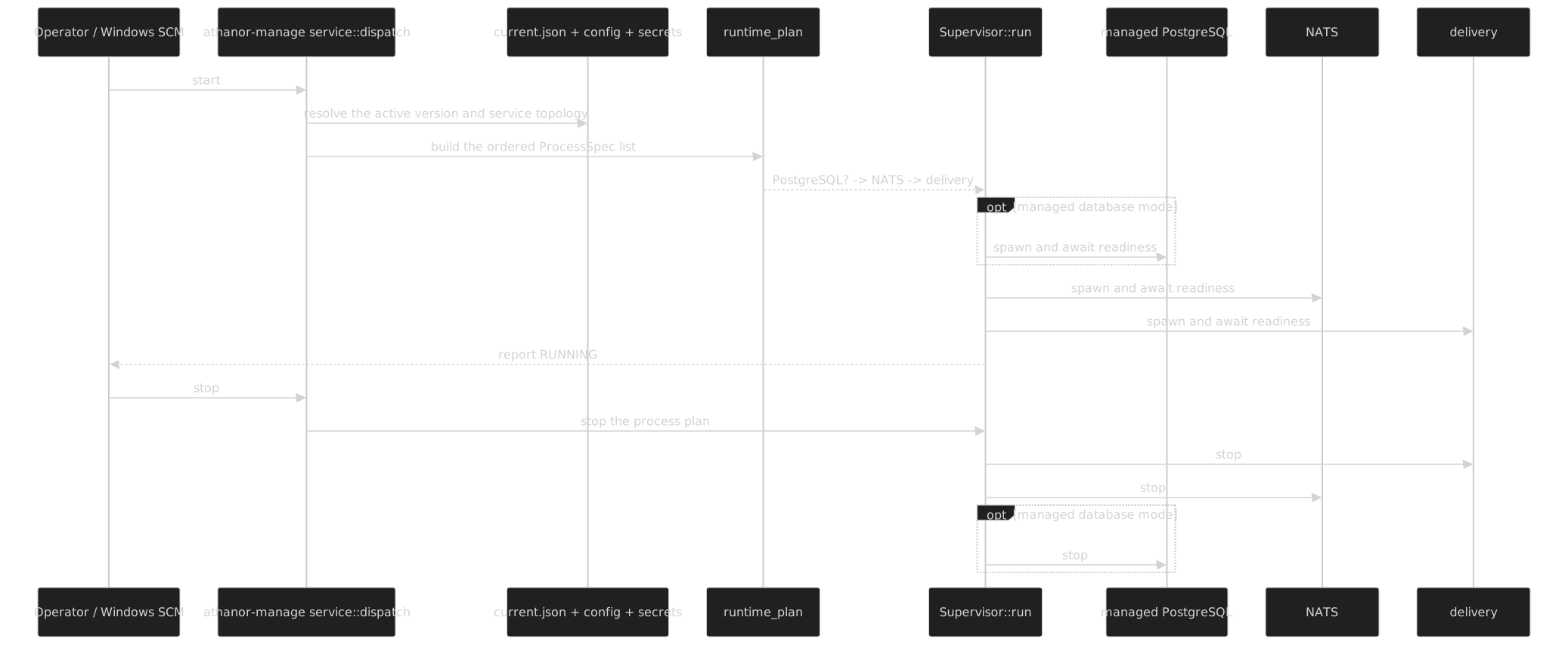
Read the diagram source
sequenceDiagram
    participant SCM as Operator / Windows SCM
    participant Manage as athanor-manage service::dispatch
    participant Layout as current.json + config + secrets
    participant Plan as runtime_plan
    participant Sup as Supervisor::run
    participant PG as managed PostgreSQL
    participant NATS as NATS
    participant Delivery as delivery

    SCM->>Manage: start
    Manage->>Layout: resolve the active version and service topology
    Manage->>Plan: build the ordered ProcessSpec list
    Plan-->>Sup: PostgreSQL? -> NATS -> delivery
    opt managed database mode
        Sup->>PG: spawn and await readiness
    end
    Sup->>NATS: spawn and await readiness
    Sup->>Delivery: spawn and await readiness
    Sup-->>SCM: report RUNNING

    SCM->>Manage: stop
    Manage->>Sup: stop the process plan
    Sup->>Delivery: stop
    Sup->>NATS: stop
    opt managed database mode
        Sup->>PG: stop
    end
A child spawn is not readiness. Failure before the full plan becomes ready is a service-start failure, not a partial success.
Sources: crates/athanor-install/src/service.rs,
crates/athanor-install/src/native_runtime.rs,
crates/athanor-install/src/supervisor.rs.
4. One OMP context turn
The ordering below is the pi.on("context") path. Conversation capture occurs
before memo replay so detached GIGA ingestion is not skipped by a cache hit.
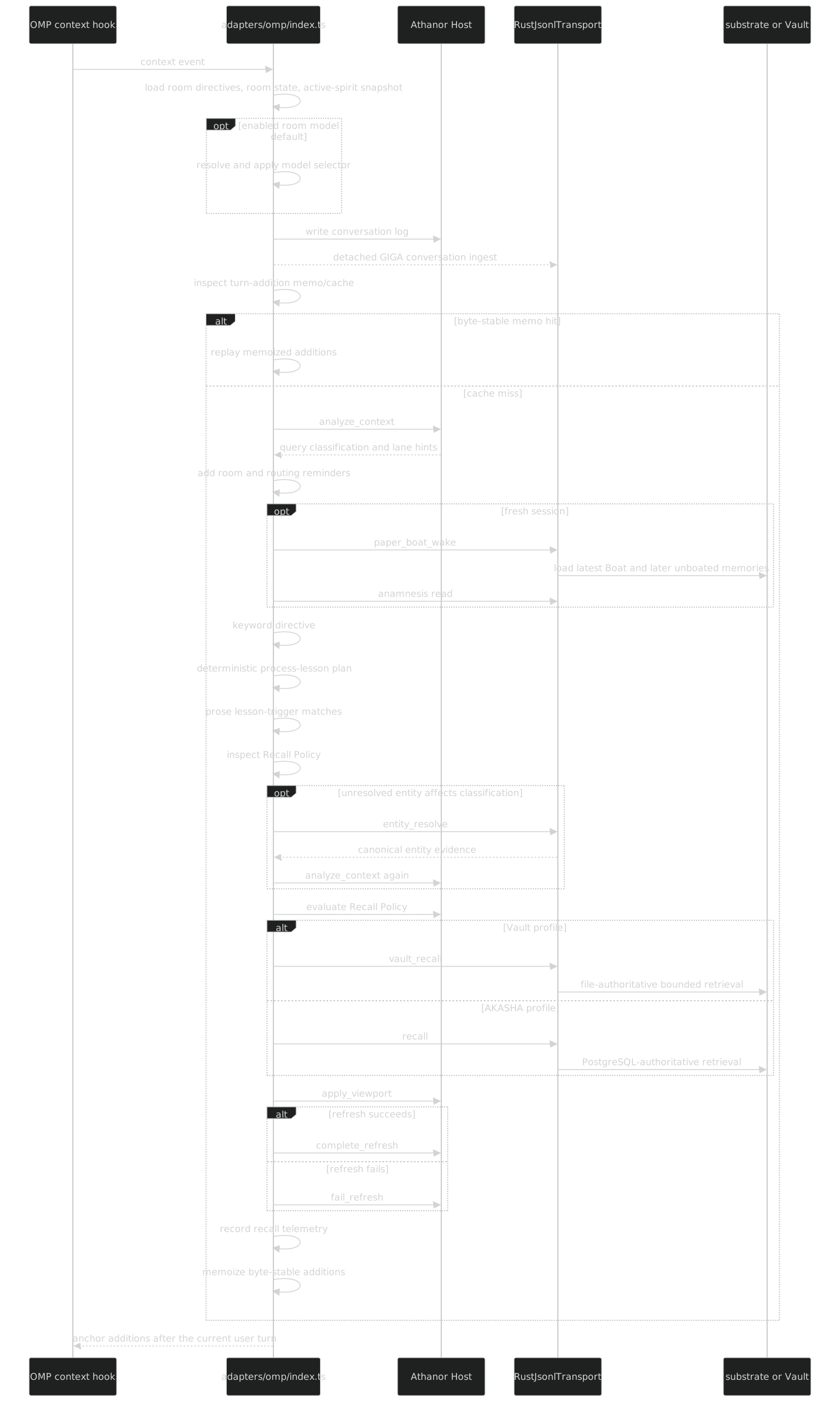
Read the diagram source
sequenceDiagram
    participant Pi as OMP context hook
    participant Adapter as adapters/omp/index.ts
    participant Host as Athanor Host
    participant Rust as RustJsonlTransport
    participant Data as substrate or Vault

    Pi->>Adapter: context event
    Adapter->>Adapter: load room directives, room state, active-spirit snapshot
    opt enabled room model default
        Adapter->>Adapter: resolve and apply model selector
    end
    Adapter->>Host: write conversation log
    Adapter-->>Rust: detached GIGA conversation ingest
    Adapter->>Adapter: inspect turn-addition memo/cache

    alt byte-stable memo hit
        Adapter->>Adapter: replay memoized additions
    else cache miss
        Adapter->>Host: analyze_context
        Host-->>Adapter: query classification and lane hints
        Adapter->>Adapter: add room and routing reminders
        opt fresh session
            Adapter->>Rust: paper_boat_wake
            Rust->>Data: load latest Boat and later unboated memories
            Adapter->>Rust: anamnesis read
        end
        Adapter->>Adapter: keyword directive
        Adapter->>Adapter: deterministic process-lesson plan
        Adapter->>Adapter: prose lesson-trigger matches
        Adapter->>Adapter: inspect Recall Policy
        opt unresolved entity affects classification
            Adapter->>Rust: entity_resolve
            Rust-->>Adapter: canonical entity evidence
            Adapter->>Host: analyze_context again
        end
        Adapter->>Host: evaluate Recall Policy
        alt Vault profile
            Adapter->>Rust: vault_recall
            Rust->>Data: file-authoritative bounded retrieval
        else AKASHA profile
            Adapter->>Rust: recall
            Rust->>Data: PostgreSQL-authoritative retrieval
        end
        Adapter->>Host: apply_viewport
        alt refresh succeeds
            Adapter->>Host: complete_refresh
        else refresh fails
            Adapter->>Host: fail_refresh
        end
        Adapter->>Adapter: record recall telemetry
        Adapter->>Adapter: memoize byte-stable additions
    end
    Adapter-->>Pi: anchor additions after the current user turn
Related lifecycle hooks:

Read the diagram source
flowchart LR
    Compact["session_compact"] --> Strip["remove recall working set"]
    Strip --> Invalidate["Host invalidateAfterCompaction"]

    Task["task tool_call / progress / lifecycle / result"] --> Normalize["Host lineage normalize / settle"]
    Normalize --> Lineage["write lineage memories"]

    End["agent_end"] --> Capture["capture final conversation"]
    Capture --> Giga["detached GIGA ingest"]

    Shutdown["shutdown"] --> Close["close Host and Rust transports"]
Sources: adapters/omp/index.ts, adapters/omp/giga.ts,
adapters/omp/kitten-lineage.ts, and adapters/omp/house-proof/.
5. OMP tool ownership and transport
The current adapter registers 35 tools. A tool name is not an authority claim; the owner column names the boundary that actually performs or persists the operation.
| Tool | Runtime owner / boundary |
|---|---|
recall |
Rust JSONL -> substrate recall or vault_recall routing |
canon_read |
Rust JSONL -> PostgreSQL canon store |
canon_write |
Rust JSONL -> guarded PostgreSQL canon write |
remember |
Rust JSONL -> typed lesson transaction or memory transaction |
delete_lesson |
Rust JSONL -> lesson store mutation |
update_lesson |
Rust JSONL -> lesson store mutation |
wake |
Rust JSONL -> paper_boat_wake |
room_state |
Adapter -> room-state file |
set_room_state |
Adapter -> room-state file plus active_spirit.md snapshot |
lessons |
Rust JSONL -> typed lesson query |
design_doc |
Rust JSONL -> design-document query |
design_doc_write |
Rust JSONL -> guarded design-document write |
sleep |
Adapter flushes GIGA buffer, then Rust JSONL -> paper_boat_sleep |
house_lane_status |
Host lane status plus substrate health probe |
familiar_status |
Host routing boundary plus room spellbook file |
familiar_dispatch |
Host routing boundary plus room spellbook; returns a packet only |
house_dispatch |
Host routing boundary; returns a packet only |
house_routing_mode |
Adapter -> room-state file |
kitten_lineage_status |
Adapter-local lifecycle diagnostics |
recall_policy |
authenticated Host Recall Policy command |
house_model_default |
Adapter -> room-state file and current OMP model resolver |
anamnesis |
Rust JSONL -> PostgreSQL Anamnesis read |
anamnesis_write |
Rust JSONL -> guarded PostgreSQL Anamnesis write |
giga_candidate_list |
Rust JSONL -> GIGA candidate store |
giga_health |
Rust JSONL -> GIGA queue/store health |
giga_queue_maintenance |
Rust JSONL -> bounded GIGA queue maintenance |
giga_review |
Rust JSONL -> trusted GIGA review transition |
giga_promote_memory |
Rust JSONL -> transactional memory promotion |
giga_promote_coding_lesson |
Rust JSONL -> transactional coding-lesson promotion |
giga_promote_project_lesson |
Rust JSONL -> consent-gated project-lesson promotion |
hallway_create |
Rust JSONL -> Hallway store |
hallway_join |
Rust JSONL -> Hallway store |
hallway_post |
Rust JSONL -> Hallway store |
hallway_read |
Rust JSONL -> Hallway store |
hallway_inbox |
Rust JSONL manual read; Host-owned automatic projection |
hallway_knock_policy |
Rust JSONL -> append-only room-owned Hallway wake policy |
hallway_knock |
Rust JSONL -> bounded Hallway Knock lifecycle |

Read the diagram source
flowchart LR
    Tools["tools.ts registrations"] --> Local["adapter-local handlers"]
    Tools --> HostClient["Host command clients"]
    Tools --> RT["RustJsonlTransport.request"]

    Local --> Files[("room files / OMP session state")]
    HostClient <-->|"authenticated WebSocket"| Host["multi-room Host router"]

    RT --> Ensure["ensureStarted"]
    Ensure --> Queue["queue and flush stdin line"]
    Queue --> Main["athanor-substrate main"]
    Main --> Decode["decode response stdout line"]
    Decode --> Handle["handleLine"]
    Handle --> RT

    Timeout["timeout after definitive dispatch"] --> Unknown["outcome unknown<br/>do not retry as if unsent"]
    RT -.-> Timeout
RustJsonlTransport keeps one child process alive and correlates JSONL request
IDs. A timeout after dispatch is explicitly outcome-unknown because replaying a
write could duplicate an operation whose response was merely lost.
Hallway Knock actuation follows a separate local path. The recipient Host claims
one PostgreSQL pointer under a short session lease; the OMP doorman includes only
trusted routing IDs in its custom wake message and invokes pi.sendMessage for
one turn. Injection settles the authoritative parent as started before the
model can answer. If the recipient is already generating, the adapter then
aborts that active turn so the bounded Knock can run next; the interrupted turn
cannot be mistaken for the Knock's completion because completion still waits
for the custom Knock message's own lifecycle. The spirit reads the exact
Hallway message through the ordinary untrusted social path.
Started/completed/failed settlement returns through Host; claiming never
advances a Hallway read cursor or clears a Bell row.
Sources: adapters/omp/house-proof/tools.ts,
adapters/omp/rust-transport.ts, adapters/omp/house-proof/host.ts,
adapters/omp/house-proof/knock.ts.
6. Substrate request router

Read the diagram source
flowchart TD
    Stdin["stdin JSONL"] --> Main["main.rs line loop"]
    Main --> Req{"ProtocolRequest"}

    Req --> Vault["vault_recall"]
    Vault --> VaultCrate["vault<br/>no database initialization"]

    Req --> Pre["health / migrations<br/>pre-init paths"]

    Req --> NeedDB["database-backed request"]
    NeedDB --> Lazy["lazy Config::from_env + pool"]
    Lazy --> Worker["spawn_giga_worker when enabled"]
    Lazy --> Router{"request family"}

    Router --> Continuity["canon, remember, paper boat,<br/>recall, entity, anamnesis"]
    Router --> Knowledge["lesson, lesson context/triggers,<br/>design documents, cluster"]
    Router --> Social["Hallway create/join/post/read/inbox<br/>Knock policy/create"]
    Router --> Giga["GIGA ingest, queue, worker,<br/>review, promotion, health"]
    Router --> Ops["substrate health and maintenance"]

    Continuity --> PG[("PostgreSQL")]
    Knowledge --> PG
    Social --> PG
    Giga --> PG
    Ops --> PG
    Worker -.-> Giga

    PG --> Resp["ProtocolResponse"]
    VaultCrate --> Resp
    Pre --> Resp
    Resp --> Stdout["stdout JSONL"]
The main binary owns protocol dispatch and lazy shared state. Domain modules own
the transactions; main.rs does not become a second implementation of their
rules.
Sources: crates/akasha/src/main.rs, lib.rs, config.rs,
health.rs, and the domain modules listed in the module index.
7. Recall paths
AKASHA profile

Read the diagram source
flowchart TD
    Q["recall request"] --> Validate["validate and normalize"]
    Validate --> Parse["extract dates and terms<br/>rooms = room + house"]
    Parse --> Embed["optional Ollama query embedding"]

    Parse --> BM["BM25F candidates"]
    Parse --> Vocab["nearest semantic vocabulary"]
    Vocab --> Bridge["BM25F concept bridge"]
    Embed --> Vector["pgvector semantic chunks"]
    Parse --> Trgm["pg_trgm word-similarity chunks"]
    Parse --> Dates["date matches"]
    Parse --> Threads["lexical thread rows"]

    BM --> Fuse["weighted rank fusion"]
    Bridge --> Fuse
    Vector --> Fuse
    Trgm --> Fuse
    Dates --> Fuse
    Threads --> Fuse

    Fuse --> Bound["dedupe and truncate"]
    Bound --> Neighbors["hydrate thread-neighbor graph"]
    Neighbors --> Canon["attach active canon matches"]
    Canon --> Cluster["attach cluster resonance"]
    Cluster --> Result["evidence + taxonomy + warnings"]
Vault profile

Read the diagram source
flowchart TD
    Q["vault_recall request"] --> Marker["load .athanor-room.json"]
    Marker --> Collect["collect eligible attributed files<br/>respect ignores and limits"]
    Collect --> Parse["parse Markdown / JSON / JSONL / text"]
    Parse --> Docs["in-memory documents"]
    Docs --> Rank["BM25F rank"]
    Rank --> Bound["bounded attributed candidates"]

    NoDB["No PostgreSQL<br/>No writes"] -.-> Q
Sources: crates/akasha/src/recall/,
crates/akasha/src/bm25f.rs, crates/vault/src/recall.rs.
8. Host command cycle

Read the diagram source
flowchart TD
    App["athanor.exe"] --> Start["host::start"]
    Start --> House["open_house"]
    House --> Pool["one shared PostgreSQL pool"]
    House --> Listener["one loopback listener"]
    House --> Rooms["nest /room/<key>"]
    Rooms --> New["Host::new for each room"]
    New --> Load["load room state, cursor,<br/>sessions, receipts, ReceiptTracker"]
    Load --> Axum["Axum room routes"]
    New -.-> Bridge["run_receipt_bridge<br/>when NATS configured"]
    Axum --> Socket["handle_socket"]
    Socket --> Text["process_text"]
    Text --> JSON["parse JSON"]
    JSON --> Hash["semantic hash"]
    Hash --> Parse["parse_client_command"]
    Parse --> Validate["validate room/spirit/session binding,<br/>expiry and hop bounds"]
    Validate --> Route{"command router"}

    Route --> Receipt["receipt / recall subscribe,<br/>resync, ack"]
    Route --> Policy["Recall Policy set/evaluate/<br/>complete/fail/invalidate"]
    Route --> Context["analyze_context / apply_viewport"]
    Route --> Routing["lane status / dispatch / familiar status"]
    Route --> Lineage["lineage normalize / settle"]
    Route --> Shell["conversation log / lesson plan / braid"]

    Policy --> Mutate["commit_change"]
    Receipt --> Mutate
    Context --> Reply["typed direct event"]
    Routing --> Reply
    Lineage --> Reply
    Shell --> Reply

    Mutate --> Version["compute mutations, version, state hash"]
    Version --> Store["persist policy, sessions, cursor,<br/>idempotency receipt"]
    Store --> Reply
    Store --> Delta["broadcast ordered delta"]
    Reply --> Socket
    Delta --> Socket

    Validate -->|"invalid"| Reject["typed rejection; no mutation"]
    Bridge --> Tracker["filter accepted / duplicate / stale /<br/>foreign / malformed receipts"]
    Tracker --> Delta
Sources: crates/athanor-install/src/app.rs, crates/host/src/house.rs,
config.rs, server.rs, policy.rs, store.rs, receipt.rs, and viewport.rs.
9. Paper Boat, Crane delivery, and receipt projection
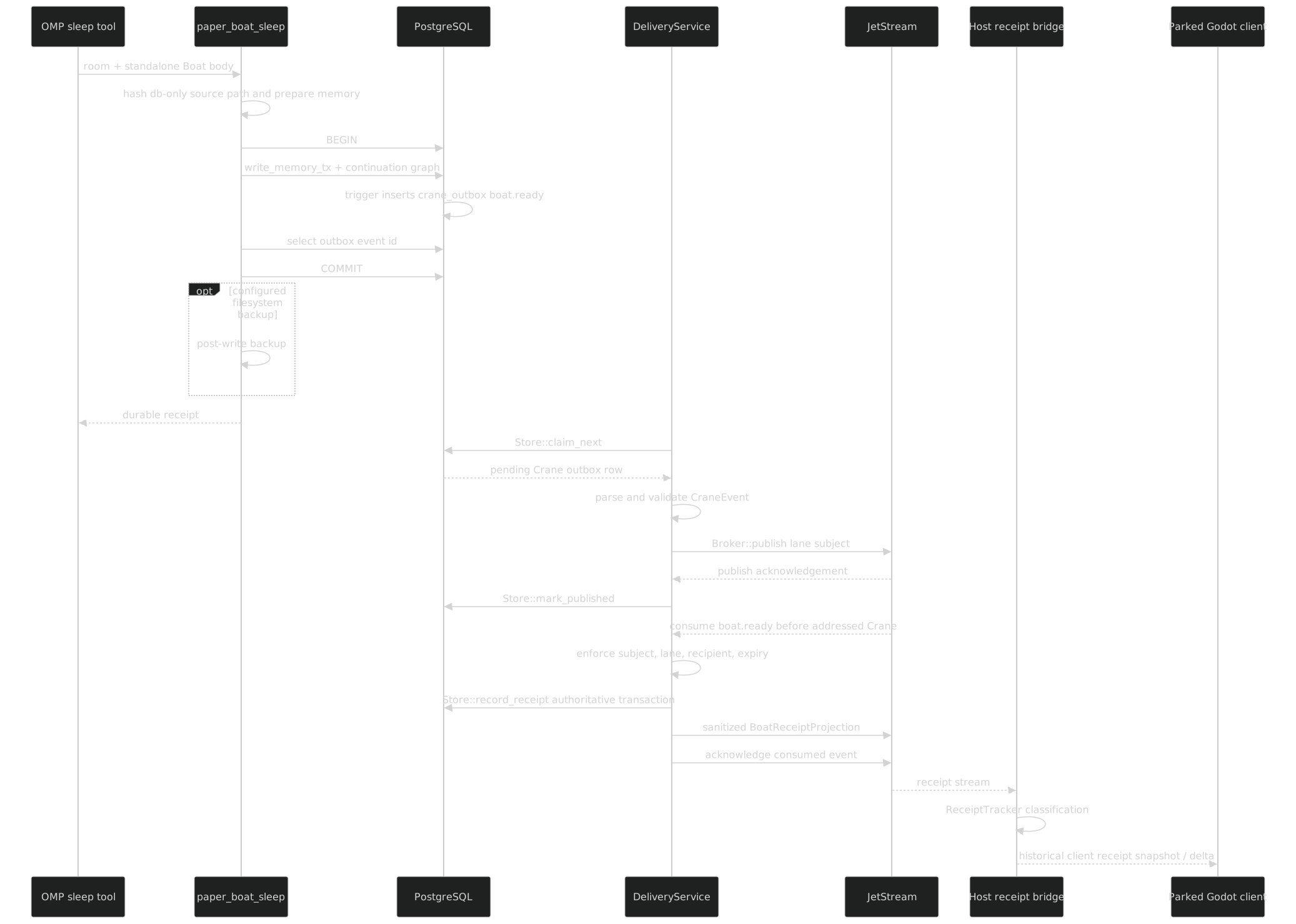
Read the diagram source
sequenceDiagram
    participant Tool as OMP sleep tool
    participant Sub as paper_boat_sleep
    participant PG as PostgreSQL
    participant Delivery as DeliveryService
    participant NATS as JetStream
    participant Host as Host receipt bridge
    participant Godot as Parked Godot client

    Tool->>Sub: room + standalone Boat body
    Sub->>Sub: hash db-only source path and prepare memory
    Sub->>PG: BEGIN
    Sub->>PG: write_memory_tx + continuation graph
    PG->>PG: trigger inserts crane_outbox boat.ready
    Sub->>PG: select outbox event id
    Sub->>PG: COMMIT
    opt configured filesystem backup
        Sub->>Sub: post-write backup
    end
    Sub-->>Tool: durable receipt

    Delivery->>PG: Store::claim_next
    PG-->>Delivery: pending Crane outbox row
    Delivery->>Delivery: parse and validate CraneEvent
    Delivery->>NATS: Broker::publish lane subject
    NATS-->>Delivery: publish acknowledgement
    Delivery->>PG: Store::mark_published

    NATS-->>Delivery: consume boat.ready before addressed Crane
    Delivery->>Delivery: enforce subject, lane, recipient, expiry
    Delivery->>PG: Store::record_receipt authoritative transaction
    Delivery->>NATS: sanitized BoatReceiptProjection
    Delivery->>NATS: acknowledge consumed event
    NATS-->>Host: receipt stream
    Host->>Host: ReceiptTracker classification
    Host-->>Godot: historical client receipt snapshot / delta
paper_boat_wake does not trust a NATS payload as continuity. It reloads the
latest complete Boat from PostgreSQL and adds a bounded set of later unboated
memories. Duplicate delivery replays safely; poison events dead-letter and
transient failures nack within bounded retry policy.
Sources: crates/akasha/src/paper_boat.rs, migrations 0016 and
0017 in crates/akasha/src/migrations.rs,
crates/origami/src/cranes/, crates/host/src/receipt.rs.
10. GIGA candidate lifecycle

Read the diagram source
flowchart TD
    Conversation["OMP conversation"] --> Capture["capture transcript + private source ledger"]
    Capture --> Ingest["GIGA conversation ingest<br/>bounded turn windows"]
    Ingest --> Events[("PostgreSQL<br/>giga_events: pending")]

    Events --> Claim["worker claim"]
    Claim --> Validate["validate claim and event bounds"]
    Validate --> Sources["resolve exact private-ledger sources"]
    Sources --> Ollama["Ollama inference<br/>gate + extraction only"]
    Ollama --> Decision{"worthy candidate?"}
    Decision -->|"no"| Finish["finish event without candidate"]
    Decision -->|"yes"| Store["atomically store one GigaCandidate<br/>in PostgreSQL and finish event"]
    Validate -->|"retryable failure"| Retry["bounded retry then failed"]

    Store --> Proposal["candidate proposal<br/>not authority"]
    Proposal --> Review["giga_review"]
    Review --> ReviewChecks["trusted room + reviewer identity +<br/>current state + exact source resonance"]
    ReviewChecks --> InReview["durable PostgreSQL<br/>in_review transition"]

    InReview --> Promote{"promotion tool"}
    Promote --> Authority["re-check authority, state, and sources"]
    Authority --> Memory["transactional memory write"]
    Authority --> Coding["transactional coding lesson write"]
    Authority --> Consent["explicit project publication consent"]
    Consent --> Project["transactional project lesson write"]
    Memory --> Record["record promotion"]
    Coding --> Record
    Project --> Record
A candidate never becomes evidence merely because the worker extracted it. Review and promotion are separate durable transitions. Project lessons add an operator publication-consent gate.
Sources: adapters/omp/giga.ts, crates/akasha/src/giga/,
crates/akasha/src/giga_worker/,
crates/hearth/src/conversation.rs.
11. Native release, install, rollback, and removal
Release assembly

Read the diagram source
flowchart LR
    Pins["installer/dependencies.json"] --> Fetch["fetch pinned PostgreSQL,<br/>pgvector, NATS, parked Godot"]
    Fetch --> Verify["hash verification + cache"]
    Verify --> Cargo["cargo release-build<br/>five binaries + parked Godot cdylib"]
    Cargo --> Stage["stage runtime, adapter, parked Godot, manager"]
    Stage --> Import["parked Godot headless import"]
    Import --> Manifest["hash payload and emit release manifest"]
package.json is the native product version authority. The OMP adapter has an
independent content-derived release identity. A native release includes a
compatible fallback component bundle, but does not include the adapter in its
native version identity.
The native builder and the shared component builder reject a missing or mismatched toolchain before they create a work directory. Each release stage appends one JSONL timing record. The workflow adds Inno packaging and retains the complete report.
Native and component ownership
| Surface | Owner | Required behavior |
|---|---|---|
Native product version, native current.json, service, and product rollback |
Rust installer | Validates and atomically activates native releases |
Adapter source bundle and component-manifest.json |
Shared PowerShell component builder | Builds source artifacts only; does not write Program Files |
Installed adapter versions and components/omp-adapter/current.json |
Rust installer | Stages, validates, atomically activates, rolls back, and diagnoses components |
Stable bin/athanor-omp-loader.ts |
Product payload | Reads native environment and component pointer; refuses invalid or incompatible imports; starts the scoped Host when health fails and keeps it alive for the whole session |
| Adapter-only deployment | Native manager | Installs a built component with install-omp-adapter --source <component-root> without rebuilding or mutating a native release |
The component pointer is
components/omp-adapter/current.json. It contains format, releaseId, and
previousReleaseId. The selected component directory is
components/omp-adapter/versions/<releaseId>.
Before activation, the installer validates the component manifest identity, each declared SHA-256 and size, and all four compatibility fields against the active or requested native manifest. The loader repeats the same refusal gate before it imports adapter code. An explicit adapter rollback refuses an incompatible target. A failed activation restores the prior component and native state.
Install or update

Read the diagram source
flowchart TD
    Start["ReleaseManifest validate"] --> Config["load House config"]
    Config --> Preflight["platform + payload hash preflight"]
    Preflight --> Mutable["create and ACL-restrict mutable dirs<br/>and room state"]
    Mutable --> Legacy["one-time legacy import"]
    Legacy --> Backup["pre-upgrade database backup"]
    Backup --> Stop["stop service"]
    Stop --> Stage["stage, copy, write manifest,<br/>atomic version rename"]
    Stage --> Stable["update stable manager, runtime config,<br/>secrets, OMP client projection"]
    Stable --> Pointer["atomically update current.json"]
    Pointer --> Migrate["run production migration registry"]
    Migrate --> Service["install or update Windows service"]
    Service --> Run["start service and await health"]
    Run -->|"ready"| Loader["register stable OMP loader"]

    Stage -->|"failure"| Restore["restore pointer and database;<br/>remove failed first install"]
    Stable -->|"failure"| Restore
    Pointer -->|"failure"| Restore
    Migrate -->|"failure"| Restore
    Run -->|"failure"| Rollback["rollback to prior release"]
Sources: package.json, rust-toolchain.toml,
installer/native-release-contract.ps1,
installer/build-native-release.ps1, installer/omp-adapter-component.ps1,
installer/native-build-cache.ps1, adapters/omp/deploy-local.ps1,
.github/workflows/release.yml, crates/athanor-install/src/installer.rs,
manifest.rs, layout.rs, boundaries.rs, omp.rs, service.rs, and
supervisor.rs.
Explicit rollback and removal

Read the diagram source
flowchart TD
    Rollback["rollback command"] --> Undo["take undo backup"]
    Undo --> Stop["stop service"]
    Stop --> Pointer["flip current pointer to prior version"]
    Pointer --> DB["restore prior database backup"]
    DB --> Start["start and await readiness"]
    Start -->|"failure"| Newer["restore newer release"]

    Uninstall["uninstall"] --> Remove["remove service, operator integration,<br/>and program files"]
    Remove --> Preserve["preserve operator data"]
    Purge["purge + explicit confirmation"] --> Destroy["remove operator data"]
Sources: package.json, rust-toolchain.toml,
installer/native-release-contract.ps1,
installer/build-native-release.ps1, installer/native-build-cache.ps1,
.github/workflows/release.yml,
crates/athanor-install/src/installer.rs, manifest.rs, layout.rs,
boundaries.rs, omp.rs, service.rs, and supervisor.rs.
12. Web operator surface and parked Godot specification

Read the diagram source
flowchart TD
    Host["Athanor Host"] <-->|WebSocket: parked client| Session["AthanorHostSession"]
    Session -->|"owns credentials and transport"| Link["HostLink"]
    Session --> Protocol["protocol.rs<br/>wire vocabulary, parsers, delta application"]
    Protocol --> Shell["shell.rs router"]

    Shell --> Resume["Resume"]
    Shell --> Policy["RecallPolicy"]
    Shell --> Routing["Routing"]
    Shell --> Familiar["Familiars"]
    Shell --> Dispatch["Dispatch"]
    Shell --> Health["Health"]

    Policy -->|"only authored mutation"| Requested["requested Recall mode"]
    Routing --> ReadOnly["read-only projections"]
    Familiar --> ReadOnly
    Health --> ReadOnly
    Dispatch --> Packet["validated OMP spawn packet<br/>never executes it"]

    Session --> Boat["PaperBoatReceipt state"]
    Boat --> Chat["S01ChatCenter"]
    Chat --> Composer["Composer<br/>visibly disabled: no conversation command"]
    Chat --> Message["MessageCard"]
    Chat --> Receipt["ReceiptCard"]
    Chat --> Disclosure["DisclosureBanner"]
    Shell --> Nav["ReliquaryNavigator"]

    Effects["Effects Lab"] -.-> Juicee["third-party Juicee plugin"]
    Prototype["gui-prototype/<br/>read-only operator surface"] --> Proxy["serve.ts: loopback proxy"]
    Proxy -->|nine POST-only /live/* read routes| Host
The Rust extension owns Host protocol state. GDScript composes the visible instrument. Generic design-system components present state but do not gain persistence or transport authority. The composer remains disabled because the Host protocol does not implement a conversation-send command.
Sources: gui/src/, gui/screens/s01_chat_center.gd,
gui/design-system/components/, gui/navigation/reliquary_navigator.gd,
gui/effects_lab/effects_lab.gd, gui/main.tscn.
13. Module ownership index
Rust production modules
| Crate | Modules | Boundary |
|---|---|---|
hearth (23) |
lib, authority, canon, cluster, context, conversation, error, giga/*, hallway, lesson_triggers, lineage, recall, remember, room, triggers |
Vocabulary and pure rules only: typed requests and receipts, context classification, transcript/source identity, Hallway validation, trigger vocabulary, quest normalization. No file, socket, database, or clock |
origami (22) |
lib, sea, boats/*, cranes/*, hallways/* |
The communication layer: paper boat records, sleep and wake; Crane envelopes, PostgreSQL outbox and receipts, JetStream broker and the delivery loop; Hallway channels, messages, Bells and Knocks over PostgreSQL |
summoning (7) |
lib, anamnesis, presence/* |
The waking cycle's typed requests: Anamnesis read and write shapes, Presence frames, turns and settlement rules |
protocol (5) |
lib, contract, harness, host, restart/* |
Substrate JSONL DTOs/results/errors, Host command/event envelopes, harness and restart wire shapes |
vault (12) |
lib, config, documents, error, ignore, index, model, rank, recall, text, walk |
Strict file-authoritative, database-free Vault retrieval |
akasha (114) |
lib, main, config, state, settings, migrations, backup, health, remember/*, recall/*, bm25f, canon, entity, anamnesis, lesson/*, cluster, paper_boat, presence, hallway, timeline, docket/*, giga/*, giga_worker/*, insula/*, insula_writer, restart/* |
JSONL dispatch, PostgreSQL configuration and migrations, durable organs, retrieval, lesson registry and trigger engine, Presence session rows, Docket, GIGA, Insula telemetry, restart intents, backup, and health |
host (15) |
lib, house, config, chat, insula, panel, policy, presence, receipt, routing/*, server, store, viewport |
One in-process multi-room listener, authenticated client boundary, room projection state, Recall Policy, receipts, panels, viewport shaping, worker lanes, spellbook dispatch, and the delivery task it spawns. Presence frames and ledgers are cached here; presence_sessions in PostgreSQL is their authority |
omp-keeper (10) |
lib, main, clock, config, control, decide, keeper, protocol, resolve, session |
Supervises one OMP session per room: restart intents, relaunch decisions, and the substrate executable it resolves |
interactive-process (1) |
lib |
Child process with a PTY-shaped stdin/stdout contract for the keeper and installer |
athanor-install (20) |
lib, main, app, bin/athanor, bin/athanor-chat, boundaries, component, endpoints, harness/*, installer, layout, manifest, native_runtime, omp, service, supervisor |
athanor.exe: installed layout, release validation, transactional update/rollback, runtime planning, Windows service supervising PostgreSQL and NATS, OMP integration, and the in-process Host |
athanor-godot (14) |
lib, host_link, host_session, protocol, shell, tokens, disclosure, recall_policy, routing, familiar_status, dispatch, health, harness_control/*, paper_boat_receipt |
Thin native client transport, exact Host wire contract, projections, shell routes, and Paper Boat receipt state (parked; the web gui-prototype/ is the operator surface) |
OMP adapter modules: 26
| Area | Modules | Boundary |
|---|---|---|
| Adapter entry and loading | index.ts, athanor-root.ts, installed-loader.ts, discovery.ts |
OMP registration, installed-source resolution, room discovery, lifecycle hooks |
| Transport and capture | rust-transport.ts, giga.ts, kitten-lineage.ts |
Long-lived substrate child, transcript/source-ledger ingestion, task lifecycle bridge |
| Standalone guard | hygiene.ts |
Repository/packaging hygiene check; not a session runtime import |
| House proof runtime | tools.ts, host.ts, context.ts, recall-policy.ts, recall.ts, substrate.ts, room.ts, conversation-log.ts, lesson-context.ts, lesson-ttsr.ts, routing.ts, lineage.ts, entity-resolution.ts, anamnesis.ts, recall-telemetry.ts, feedback.ts, text.ts, constants.ts |
Tool registration, Host clients, context assembly, retrieval routing, room files, native lesson guards, lineage, entity handling, telemetry, and shared text/constants |
Parked Godot GDScript
| Area | Modules | Boundary |
|---|---|---|
| Product screen | screens/s01_chat_center.gd |
S01 composition and visible session/receipt state |
| Navigation | navigation/reliquary_navigator.gd |
Shell navigation projection |
| Design components | receipt_card, consequence_button, composer, message_card, evidence_card, status_channel, text_action, disclosure_banner, field_row, reliquary_panel, page_header, ritual_surface |
Presentation components; no persistence or transport authority |
| Effects lab | effects_lab/effects_lab.gd |
Separate visual experiment using the external Juicee plugin |
| External plugin | addons/juicee/ |
Third-party effect implementation treated as one dependency node |
| Proof satellites | navigation/tests/, screens/tests/, effects_lab/tests/ |
Parked Godot smoke and contract checks; not runtime ownership |
Operational surfaces
| Path | Responsibility |
|---|---|
package.json |
Native product version authority and local command entry points |
adapters/omp/package.json |
Adapter component version authority |
rust-toolchain.toml |
Pinned Rust toolchain authority |
installer/native-release-contract.ps1 |
Version resolution, toolchain identity, early refusal, and stage timing |
installer/native-release-contract.test.ps1 |
Isolated proof for the native release contract |
installer/omp-adapter-component.ps1 |
Shared source-only component builder and component identity authority |
installer/omp-adapter-component.test.ps1 |
Isolated proof for component manifest, artifact, and identity contracts |
adapters/omp/deploy-local.ps1 |
Adapter-only test, build, and manager deployment; never writes Program Files directly |
installer/build-native-release.ps1 |
Fetch, verify, compile, stage, import, hash, and assemble a native payload with its fallback component |
installer/native-build-cache.ps1 |
Deterministic dependency cache used by release assembly |
installer/athanor.iss |
Windows installer packaging |
.github/workflows/release.yml |
Product and component build proof, Inno packaging, and retained release proof |
substrate/deploy-local.ps1 |
Local substrate deployment helper |
substrate/state_paths.sh |
Shared local state-path resolution for substrate operations |
.github/workflows/ci.yml |
CI proof; not runtime |
tests/, crate tests, substrate/tests/ |
Cross-boundary proof satellites |
gui-prototype/ |
Read-only web operator surface; nine POST-only /live/* routes through serve.ts to the Host |
14. Fast traversal paths
- A prompt gains continuity: section 4 -> section 5 -> section 6 -> section 7 -> section 8 -> back to the OMP context.
- A Boat becomes visible in parked Godot: section 9 -> Host receipt bridge in section 8 -> parked Godot receipt projection in section 12.
- A conversation proposes durable knowledge: section 4 capture -> section 10 candidate/review/promotion -> substrate transaction in section 6.
- The installed system starts: section 11 install -> section 3 service plan -> section 1 runtime topology.
- A worker is selected: OMP tool table -> Host routing family in section 8 -> returned spawn packet; the main model still invokes the OMP task tool explicitly.